Confinement and the desire for freedom
The House of Bernarda AlbaConfinement and the desire for freedom are central to the architecture and dramatic tension of The House of Bernarda Alba. The house’s thick walls, shut windows, and ground-floor rooms turn restriction into a material fact, while voices reaching from outside and visions of open doors make freedom imaginable but precarious. The women are not merely kept indoors: their work, marriage prospects, reputations, and access to speech are also controlled. The contrast between enclosure and escape reveals the pressure beneath the household’s orderly appearance.
The House as a Material Prison
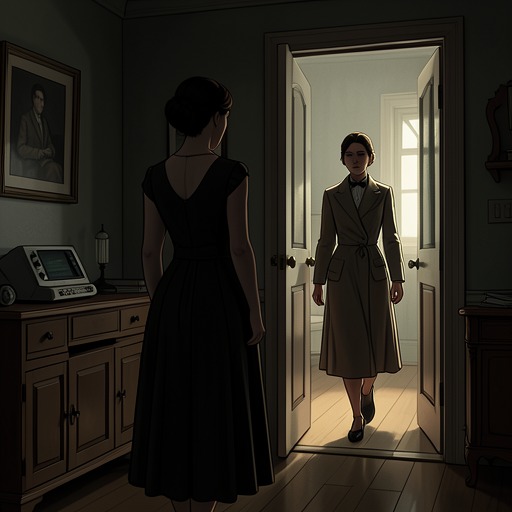
The house is mapped with unusual precision: its patio leads toward a stable-yard and a great door opening onto the street, while the bedrooms face the street behind windows. Angustias can overhear men outside through the great door; from her own room Adela can see Pepe el Romano when he turns the corner, and Angustias speaks to her suitor through a barred window. These openings permit glimpses and fragments of contact, but they do not offer free passage. A window can bring the outside world close while its bars keep the women on the inside.
The stage directions deepen that spatial meaning. The house’s white walls are realistic, yet their whiteness also suggests the daughters’ expected purity, Bernarda Alba’s concern with an unblemished reputation, and the monotony and sterility of their lives. The thick walls suggest physical and emotional imprisonment. Meanwhile, paintings of implausible landscapes evoke a magical world from which the women are excluded. The house therefore contains both a visible boundary and an image of elsewhere: the imagined landscape makes absence part of the setting.
Mourning, Labor, and Restricted Lives
After her husband’s death, Bernarda Alba decrees that the eight-year mourning period will keep the wind from the street out of the house, as if doors and windows had been sealed with bricks. She invokes the precedent of her father’s and grandfather’s houses, making confinement appear not as an exceptional response but as inherited custom. She directs the daughters toward their trousseaus and the twenty pieces of linen stored in a chest for sheets, assigning Magdalena the embroidery. Mourning thus regulates movement and fills the women’s time with domestic preparation, even as the future marriages these trousseaus anticipate remain uncertain.
That domestic discipline reflects the traditional division of village life described in the play: women sew and embroider, while men enjoy greater freedom beyond the household. The daughters face the prospect of spinsterhood or an arranged, loveless marriage, and the prospect of marriage does not simply cancel confinement. Bernarda’s advice to Angustias about her future husband is to speak when he speaks and look at him when he looks at her. The house’s restrictions are therefore bound to a wider expectation that women should serve, obey, and remain within a domestic role.
The contrast between the household’s material wealth and its restrictive routine sharpens this order. Bernarda says she spent sixteen thousand reales on the furniture; Poncia identifies the wardrobe with a mirror as its best piece, though Prudencia says she has never seen one. Fine furnishings and lace mark the household’s status, but they do not give the daughters freedom. Bernarda’s wealth also gives her power over people working on her land, and her contempt for the poor—whom she calls animals—shows that the household’s hierarchy extends beyond its walls. The domestic order depends on both women’s constrained labor and class authority.
Outside Voices and the Watchful Household
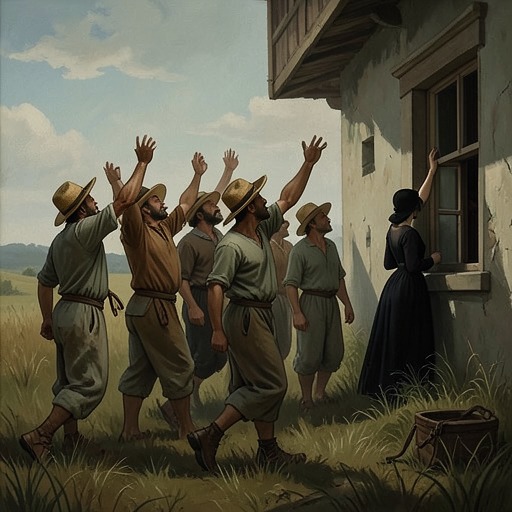
The annual arrival of the harvesters brings a sound from the outside into the women’s confined world. Their song calls to girls who live in the town and invokes the reaper seeking their roses. Poncia tries to silence the response, but Adela proposes that they watch from her bedroom window. Poncia warns her not to open it too far, in case the men push it to see who is looking. The moment holds attraction and danger together: the women can look toward the men, but even looking risks an intrusive gaze from outside.
Bernarda presents herself as able to contain every threat through watchfulness. She insists there is nothing in the house beyond her vigilance, but Poncia draws a distinction between appearances and inward life: nothing is visible outside, she says, while the daughters live as if kept in a cupboard; neither Bernarda nor anyone else can see into their hearts. Bernarda answers that her daughters breathe easily. The exchange makes surveillance itself part of confinement. The house may appear quiet and controlled, but its visible order cannot reveal or govern everything the women feel.
Escape Imagined in Song and Speech
The language of openness recurs in song. María Josefa imagines entering through an open door and hiding on the shore in a cabin made of coral; elsewhere she longs for houses that are open, for neighbors with their small children, and for a life beyond the fields. Her images answer the household’s sealed doors with movement toward a shore and a community of homes. The longing is not a practical escape plan: it is a voiced alternative to the silence and mourning imposed inside Bernarda’s house.
Her speech also sets fertility and repetition against the household’s luto, or mourning. María Josefa imagines successive generations of white-haired children becoming like waves, one after another, until they turn to foam. She asks why there is no foam there, where there are only mourning mantles. The vision contrasts continuing life and a shared world with a household clothed in grief. Yet the wish to leave is accompanied by fear that dogs will bite her as she goes out. Freedom is desired, but the imagined threshold is not free of danger.
Meaning and Consequences
The confinement of Bernarda’s daughters is at once spatial, social, and inward. Walls and barred windows restrict their movement; sewing, mourning, and marital obedience prescribe their roles; surveillance attempts to keep their feelings from becoming visible. Against this system, the harvesters’ song, Adela’s wish to watch from the window, and María Josefa’s open-door and shoreline images make desire audible. The house’s apparent stillness therefore contains a pressure its authority cannot fully read.
This tension gives the domestic setting its broader significance. The play’s portrait of village life treats women’s domestic role, long mourning, gossip, and marriage prospects as recognizable social conditions, not merely the eccentric rules of one household. Bernarda’s claim to control what happens inside is answered by Poncia’s recognition that inward life exceeds what watchfulness can see. The closed house stands as both a real place and a structure of authority: its boundaries make confinement visible, while every song or image of an opening shows that the desire for freedom survives within them.